Handball Skills Lesson Plan: Step-by-Step Teaching Guide for Students
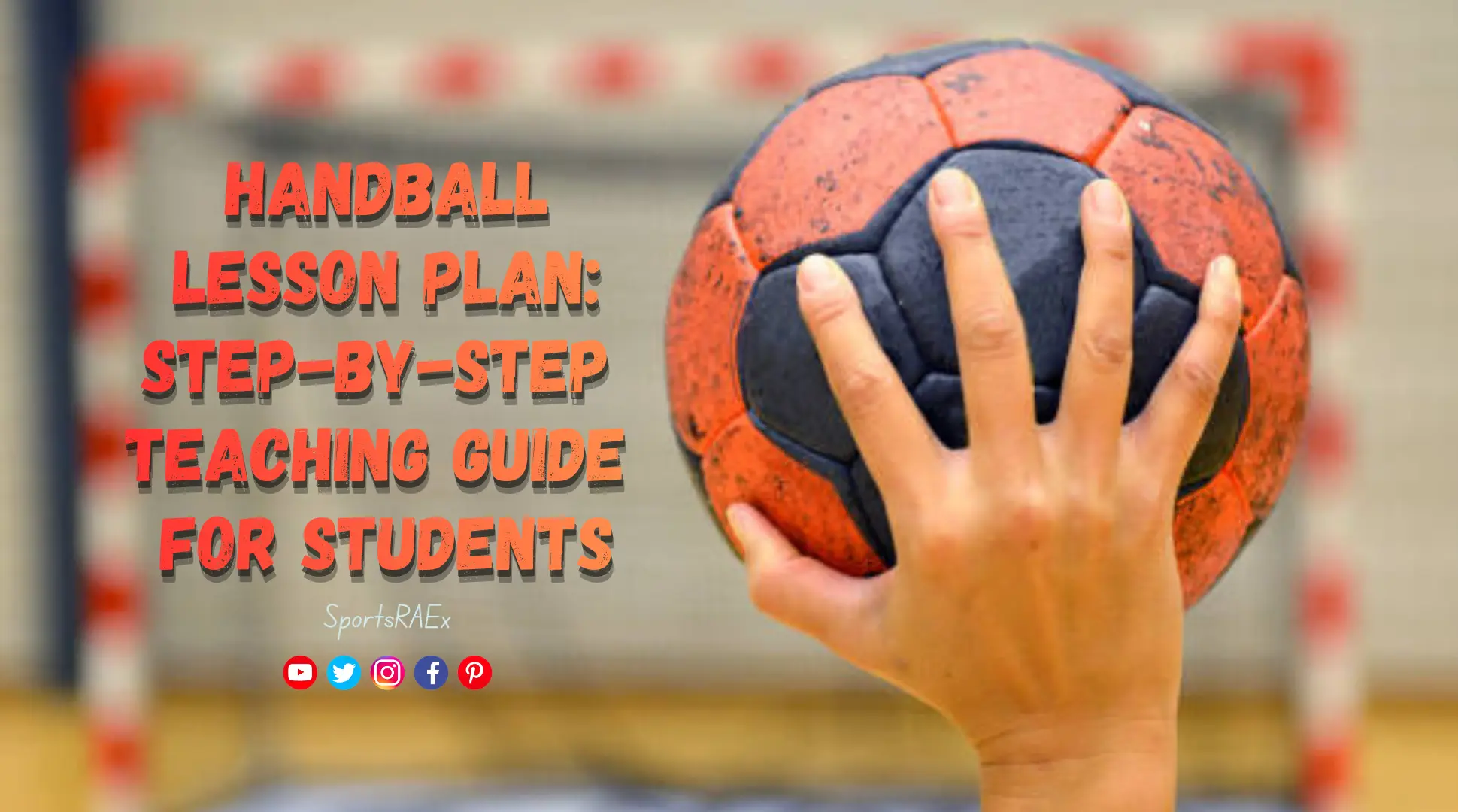
Q > Handball Specific Skills
TOTAL SPECIFIC SKILLS IN HANDBALL: 12 Major Specific Skills
A) OFFENSIVE (ATTACKING) SKILLS – 7 Skills
- Passing
- Catching (Receiving)
- Dribbling
- Shooting
- Feinting (Body & Ball Feints)
- Pivot Play (Screening & Positioning)
- Fast Break / Counter Attack
a) PASSING
- Purpose: To move the ball quickly to teammates and create scoring chances.
- Types: Chest pass, Bounce pass, Overhead pass, Side pass, Jump pass, Behind-the-back pass
- Importance: Builds team coordination, Breaks defensive formations, Maintains ball possession
- Key Factors: Accuracy, Proper grip and wrist action, Eye contact, and timing
b) CATCHING (RECEIVING)
- Purpose: To gain control of the ball from a teammate.
- Types: Two-hand catch, One-hand catch, High catch, Low catch, Jump catch
- Importance: Prevents turnovers, helps in quick attack continuation
- Key Factors: Soft hands, Body balance, Eyes on the ball
c) DRIBBLING
- Purpose: To move with the ball while avoiding defenders.
- Types: Low dribble, Speed dribble, Change-of-direction dribble
- Importance: Helps in 1-vs-1 situations, creates space
- Key Factors: Ball control, Use of fingertips, Body shielding
d) SHOOTING
- Purpose: To score goals.
- Types: Standing shot, Jump shot, Dive shot, Hip shot, Spin shot, Underarm shot
- Importance:
- Decides match outcome, Converts opportunities into goals
- Key Factors: Arm speed, Body coordination, Accuracy and timing
e) FEINTING
- Purpose: To deceive defenders and create attacking space.
- Types: Body feint, Ball feint, Direction feint, Shot feint
- Importance: Breaks strong defenses, creates clear shooting chances
- Key Factors: Speed of execution, Balance, Reading defender’s movement
f) PIVOT PLAY
- Purpose: To create space near the goal area and assist attackers.
- Types: Screening, Blocking defenders, Quick turn and shoot
- Importance: Disturbs defensive structure, increases scoring chances
- Key Factors: Strong body position, Timing, Coordination with teammates
g) FAST BREAK / COUNTER ATTACK
- Purpose: To score quickly before the defense organizes.
- Types: Individual fast break, Team fast break
- Importance: High scoring efficiency, uses opponent’s mistakes
- Key Factors: Speed, decision-making, and accurate passing
B) DEFENSIVE SKILLS – 4 Skills
a) DEFENSIVE STANCE & FOOTWORK
- Purpose: To stop attackers effectively.
- Types: Side steps, Backward movement, Closing angles
- Importance: Foundation of good defense
- Key Factors: Low center of gravity, Quick feet, Balance
b) BLOCKING
- Purpose: To stop shots or passes.
- Types: Standing block, Jump block
- Importance: Reduce the shooting accuracy of opponents
- Key Factors: Correct timing, Arm extension, and anticipation
c) STEALING / INTERCEPTING
- Purpose: To regain possession.
- Types: Pass interception, Ball stealing
- Importance: Creates counterattack chances
- Key Factors: Reading the game, Quick reaction, Hand speed
d) TACKLING / MARKING
- Purpose: To control or stop the attacker legally.
- Types: Man-to-man marking, Zone defense, Body check (legal)
- Importance: Prevents easy goals
- Key Factors: Legal body position, Strength, Timing
C) GOALKEEPING SKILLS – 1 Skill (with Sub-skills)
a) GOALKEEPING
- Purpose: To prevent goals and organize defense.
- Types: Standing saves, Jump saves, Split saves, Reaction saves
- Importance: Last line of defense, Match-winning role
- Key Factors: Reflexes, Positioning, Anticipation and Courage
SUMMARY TABLE (FOR EXAMS & TEACHING)
| Category | No. of Skills |
| Attacking Skills | 07 |
| Defensive Skills | 04 |
| Goalkeeping Skills | 01 |
| TOTAL | 12 |
Coaching Tip 🎯
- For school and college students, always teach:
- Basic passing → catching → shooting → defense
- Before moving to advanced skills like feints and fast breaks
Q > OFFENSIVE (ATTACKING) SKILLS
Q > Passing in Handball
Handball Passing { Chest pass / Bounce pass / Overhead pass / Side pass / Jump pass / Behind-the-back pass } pass Skill in Total 4 steps
a) HANDBALL PASSING SKILL – 4 TEACHING STEPS
✅ i) Step 1: Ready Position (Stance & Grip)
- Stand facing the target (teammate).
- Feet shoulder-width apart, one foot slightly forward.
- Hold the ball with one hand behind the ball and support it with the other hand.
- Elbow bent, ball near shoulder level.
👉 Teaching cue: “Face the target – elbow up – eyes forward.”
✅ ii) Step 2: Arm Preparation (Back Swing)
- Move the throwing arm backward.
- The body slightly turns sideways.
- The non-throwing shoulder points toward the target.
👉 Teaching cue: “Turn your body – prepare your arm.”
✅ iii) Step 3: Forward Action & Release
- Step forward with the opposite foot.
- Rotate hips and shoulders forward.
- Extend the arm and release the ball with a wrist snap.
- Fingers point toward the target after release.
👉 Teaching cue: “Step – throw – snap the wrist.”
✅ iv) Step 4: Follow Through & Balance
- The arm continues forward naturally.
- Body weight shifts forward.
- Maintain balance and be ready to move again.
👉 Teaching cue: “Follow through – stay balanced.”
B) KINESIOLOGICAL APPLICATION OF HANDBALL PASSING
| KINESIOLOGICAL APPLICATION OF HANDBALL PASSING | ||
| SNo | Joints Involved | Muscles Involved |
| 1 | Shoulder joint – main throwing movement | Deltoid – lifting and moving the arm |
| 2 | Elbow joint – extension during pass | Pectoralis major – forward arm movement |
| 3 | Wrist joint – flick/snap at release | Triceps brachii – elbow extension |
| 4 | Hip joint – rotation for power | Wrist flexors – wrist snap |
| 5 | Biceps brachii – control of the elbow | |
| 6 | Knee joint – support and balance | Core muscles (abdominals & obliques) – body rotation and stability |
| 7 | Quadriceps & hamstrings – leg support and stepping | |
C) RECREATIONAL GAME TO IMPROVE HANDBALL PASSING
✅ i) Name of the Game: 👉 “Pass and Move Circle.”
✅ ii) Process to Play the Game
- Players stand in a circle (6–10 players).
- One ball is used.
- Player passes the ball to any teammate.
- After passing, the player runs to a new space in the circle.
- The game continues with quick passes and movement.
✅ iii) Rules of the Game
- Pass must be accurate and controlled.
- No holding the ball for more than 3 seconds.
- No dribbling allowed.
- If the ball drops, the group restarts.
- Encourage correct passing technique only.
🔹 WHY THIS GAME IS USEFUL (For Teaching)
- Improves passing accuracy
- Develops quick decision-making
- Encourages movement after the pass
- Fun and stress-free for beginners
🔹 Coach’s Tip 🏐
- Start with:
- Short distance passes
- Then increase the distance and speed
- Finally add defenders
Q > Handball Catching ( Receiving ) Skills
Handball CATCHING (RECEIVING) {Two-hand catch / One-hand catch / High catch / Low catch / Jump catch } pass Skill in Total 4 steps
a) HANDBALL CATCHING (RECEIVING) – TOTAL 4 STEPS
Applies to: Two-hand catch, One-hand catch, High catch, Low catch, Jump catch
✅ i) Step 1: Ready Position
- Stand facing the passer
- Feet shoulder-width apart, knees slightly bent.
- Hands up, fingers spread and relaxed.
- Eyes on the ball
👉 Teaching cue: “Eyes on the ball, hands ready like a basket.”
✅ ii) Step 2: Move to the Ball
- Step forward, sideways, or jump depending on the ball height
- Adjust the body to be under the ball
- Keep elbows slightly bent to absorb impact.
👉 Teaching cue: “Move to the ball, get under it, stay balanced.”
✅ iii) Step 3: Catch the Ball
- Use both hands for normal passes; one hand if needed
- For high passes: reach up.
- For low passes: bend knees and reach down.
- Softly pull the ball toward your chest to control it
- Maintain eyes on the ball until fully caught
👉 Teaching cue: “Soft hands, pull to chest, secure it.”
✅ iv) Step 4: Follow Through / Ball Control
- Keep the ball close to your body. Ready to pass, shoot, or dribble immediately.
- Maintain balance and stability.
👉 Teaching cue: “Hold it, stay ready, stay balanced.”
b) KINESIOLOGICAL APPLICATION OF CATCHING
| KINESIOLOGICAL APPLICATION OF HANDBALL CATCHING | ||
| SNo | Joints Involved | Muscles Involved |
| 1 | Shoulder joint – arm movement and reach | Upper Body Muscles |
| 2 | Deltoid – lifting arms to catch | |
| 3 | Elbow joint – flexion to absorb impact | Biceps brachii – elbow flexion |
| 4 | Forearm muscles – wrist control and soft catch | |
| 5 | Wrist joint – control and adjust the ball | Pectoralis major – bringing the ball to the chest |
| 6 | Lower Body Muscles | |
| 7 | Hip joint – bending/rotation for low/high catches | Quadriceps – knee bending and stability |
| 8 | Hamstrings – support for jumps | |
| 9 | Knee joint – stability, bending, and jump catch | Gluteus muscles – balance |
| 10 | Core muscles (abdominals & obliques) – body control | |
c) RECREATIONAL GAME TO IMPROVE CATCHING
✅ i) Name of the Activity/Game: 🎯 “Catch and Move Relay.”
✅ ii) Process to Play the Activity/Game
- Divide students into 2–3 teams
- Place markers or cones along a line
- First player stands at the start, passer stands 3–5 meters away
- The passer throws the ball (normal, high, or low) to the catcher
- The catcher must receive properly and move to the next cone.
- Continue until all teammates complete passes.
✅ iii) Rules of the Activity/Game
- Catch must be clean (secure the ball without dropping)
- Use both hands, unless intentionally practicing one-hand catch.
- Step, jump, or bend to adjust to the ball height.
- One point for each successful catch
- No holding the ball for more than 3 seconds.
🔹 Benefits of This Game
- Improves hand-eye coordination
- Teaches catching under different conditions (high/low/one-hand/jump)
- Builds quick reaction and movement
- Fun, competitive, and suitable for all ages
🔹 Final Coaching Tip 🏐
- Start with slow passes, then gradually increase speed.
- Focus on soft hands, eye contact, and body alignment
- Always emphasize catch → control → ready for next action
Q > Handball Dribbling Skills
Handball DRIBBLING { Low dribble, Speed dribble, Change-of-direction dribble } Skill in Total 4 steps
a) HANDBALL DRIBBLING SKILL – TOTAL 4 STEPS
Applies to: Low dribble / Speed dribble / Change-of-direction dribble
✅ i) Step 1: Ready Position
- Stand with feet shoulder-width apart
- Knees slightly bent, body low, and balanced
- Hold the ball with one hand (dominant hand for first practice)
- Eyes looking forward, not at the ball.
- Keethe p other arm out for balance.
👉 Teaching cue: “Low stance, eyes up, hand on the ball.”
✅ ii) Step 2: Ball Control
- Bounce the ball firmly but controlled on the floor.r
- Use fingertips, not the palm.
- Keep the ball at the waist to knee level.4l
- Control height for low dribble; higher bounce for speed dribble
👉 Teaching cue: “Fingertips, controlled bounce, keep eyes up.”
✅ iii) Step 3: Movement
- Step forward with small, quick steps.
- Move the ball along as you walk, jog, or sprint.
- For change-of-direction dribble: pivot or side-step while controlling the ball
- Keep your body low and balanced to protect the ball.
👉 Teaching cue: “Step with the ball, protect it, move confidently.y”
✅ iv) Step 4: Finishing / Transition
- End dribble with either:
- Pass
- Shot
- Another move (feint, jump pass, etc.)
- Keep balance and be ready to react.
👉 Teaching cue: “Control to pass, shoot, or change direction.”
b) KINESIOLOGICAL APPLICATION OF DRIBBLING
| KINESIOLOGICAL APPLICATION OF HANDBALL DRIBBLING | ||
| SNo | Joints Involved | Muscles Involved |
| 1 | Wrist joint – controls ball bounce | Upper Body Muscles |
| 2 | Deltoid – lifts and controlsthe arm | |
| 3 | Elbow joint – flexion/extension for dribble | Triceps & Biceps – elbow control for bounce |
| 4 | Forearm muscles – finger control and wrist snap | |
| 5 | Shoulder joint – assists arm movement and ball control. | Lower Body Muscles |
| 6 | Quadriceps – step, sprint, and knee bend | |
| 7 | Hip joint – stepping and body rotation for direction change | Hamstrings – balance and change of direction |
| 8 | Gluteus maximus – forward propulsion | |
| 9 | Knee joint – bending, jumping, and stability | Calf muscles (Gastrocnemius) – sprint and quick push |
| 10 | Ankle joint – push-off, sprinting, and balance | Core muscles (Abs & Obliques) – balance and torso control |
c) RECREATIONAL GAME TO IMPROVE DRIBBLING
✅ i) Name of the Activity/Game: 🎯 “Dribble Obstacle Relay.”
✅ ii) Process to Play the Activity/Game
- Set up cones, markers, or hoops in a zigzag or straight line
- Divide students into 2–3 teams.
- Each player dribbles the ball through the obstacle course.e
- After reaching the end, the player passes the ball to the next teammate
- Continue until all teammates complete the course
✅ iii) Rules of the Activity/Game
- Only one-hand dribble allowed
- Ball must not be carried (no double-touching)
- Must dribble around all cones or obstacles
- One point for completing the course without errors
- The fastest team with accurate dribbling wins.
🔹 Benefits of This Game
- Improves ball control and dribbling technique
- Develops agility, coordination, and speed
- Teaches change-of-direction dribble under control
- Fun, competitive, and easy for beginners
🔹 Final Coaching Tips 🏐
- Start witha slow dribble, then increase speed
- Focus on low stance, eyes up, fingertips control.
- Emphasizthe e body between the ball and the defender for protection.
- Combine dribbling → pass → shot for game realism
D > Handball Shooting Skills
a) HANDBALL SHOOTING SKILL – TOTAL 4 STEPS
Applies to: Standing shot / Jump shot / Dive shot / Hip shot / Spin shot / Underarm shot
✅ i) Step 1: Ready Position
- Face the goal
- Feet shoulder-width apart
- Knees slightly bent
- Hold the ball firmly in the shooting hand (support hand on the side)
- Eyes on the goal and the goalkeeper
👉 Teaching cue: “Balanced body, eyes on goal.”
✅ ii) Step 2: Preparation
- Draw the ball backward near the shoulder or hip (as per shot type)
- Non-shooting shoulder points toward the goal
- Body weight on the back foot
- For jump/dive shots: bend knees to load power
👉 Teaching cue: “Pull back, aim, prepare power.”
✅ iii) Step 3: Action (Shooting)
- Step forward or jump/dive depending on the shot
- Rotate the trunk and shoulder
- Extend the shooting arm fast.
- Snap wrist and fingers
- Aim at corners or gaps in the goal
👉 Teaching cue: “Step/Jump – Rotate – Throw –Sn. ap.p”
✅ iv) Step 4: Follow Through & Recovery
- The shooting arm follows the direction of the shot.
- Body weight moves forward.d
- Land safely (for jump/dive shots)
- Get ready for defense iimmediatelyyy
👉 Teaching cue: “Follow through, land soft, recover fast.”
b) KINESIOLOGICAL APPLICATION OF SHOOTING
| KINESIOLOGICAL APPLICATION OF HANDBALL PASSING | ||
| SNo | Joints Involved | Muscles Involved |
| 1 | Shoulder joint – main throwing movement | Upper Body Muscles |
| 2 | Deltoid – arm lift and rotation | |
| 3 | Elbow joint – extension during release | Pectoralis major – forward arm drive |
| 4 | Latissimus dorsi – powerful pull | |
| 5 | Wrist joint – wrist snap for accuracy | Triceps brachii – elbow extension |
| 6 | Forearm muscles – wrist snap and control | |
| 7 | Hip joint – trunk rotation and power transfer | Lower Body Muscles |
| 8 | Quadriceps – knee extension and jump | |
| 9 | Knee joint – bending, jumping, landing | Hamstrings – control and balance |
| 10 | Gluteus maximus – power generation | |
| 11 | Ankle joint – push-off and balance | Calf muscles (Gastrocnemius) – push-off |
| 12 | Core muscles (Abs & Obliques) – trunk rotation and stability | |
c) RECREATIONAL GAME TO IMPROVE SHOOTING
✅ i) Name of the Activity/Game: 🎯 “Target Goal Shooting Game.”
✅ ii) Process to Play the Activity/Game
- Divide students into 2–3 teams
- Place targets (cones/hoops) in different goal corners
- Players take turns shooting using different shot types (standing, jump, underarm, etc.)
- After shooting, the player collects the ball and joins the back of the line.
- Continue for a fixed time or number of shots
✅ iii) Rules of the Activity/Game
- Only handball shooting techniques are allowed
- One shot per turn
- One point for hitting the target or scoring a goal
- No crossing the goal-area line
- The team with the maximum points wins
🔹 Benefits of This Game
- Improves shooting accuracy and confidence
- Encourages the use of different shooting techniques
- Develops power, timing, and aim
- Fun and motivating for students
🔹 Shot-Specific Teaching Tips (Quick Guide)
- Standing shot: Focus on balance & wrist snap
- Jump shot: Emphasize jump timing & landing
- Dive shot: Teach safety and soft landing first
- Hip shot: Stress, surprise, and quick release
- Spin shot: Practice wrist and finger control
- Underarm shot: Teach deception and low aim
🔹Final Coaching Advice 🏐
- Teach standing → jump → advanced shots in progression
- Correct common mistakes:
- ❌ no wrist snap
- ❌ poor body rotation
- ❌ shooting straight at the goalkeeper
- Always link pass → shoot in drills